
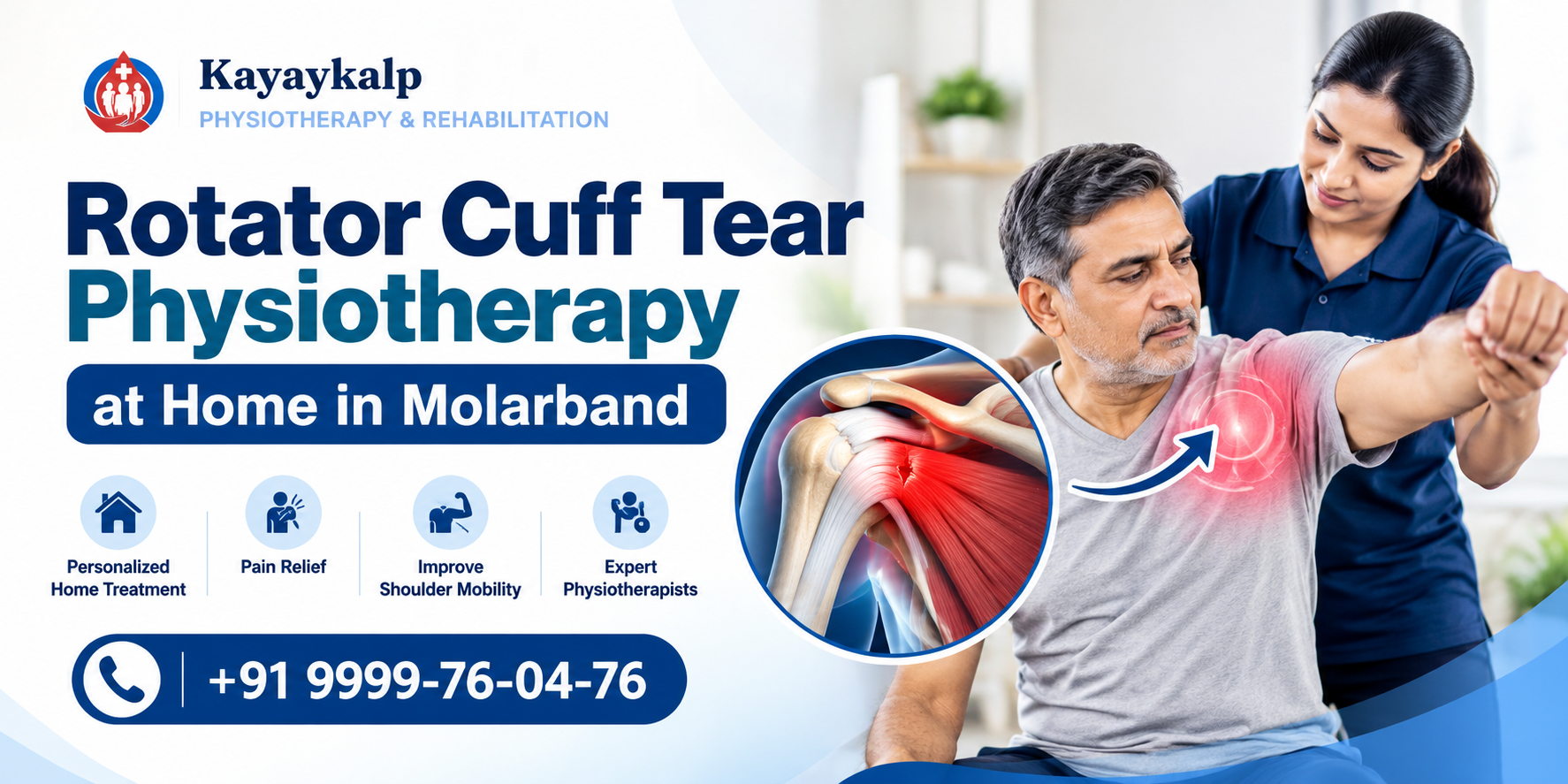
Rotator Cuff Tear Treatment at Home in Molarband, Tajpur Pahari & Mithapur
Haath upar uthate hi shoulder me tez dard? Raat ko dard wale kandhe par let nahi pa rahe? Kayaykalp's certified physiotherapists visit your home and treat the real cause of a rotator cuff tear, so you can lift, reach and sleep comfortably again, often without surgery.
A rotator cuff tear is one of the most common reasons adults over 40 develop persistent shoulder pain. It often starts quietly: a dull ache while combing your hair, trouble fastening a bra strap or reaching the top shelf, and a nagging pain at night. Many people in Molarband, Tajpur Pahari, Mithapur and the wider South Delhi and Delhi NCR belt ignore it for months, blaming "age" or a pulled muscle, and by the time they seek help the tear has often grown.
The encouraging news is that a large number of rotator cuff tears, especially partial tears, improve well with rotator cuff tear physiotherapy at home when the treatment is started early and guided properly. In this complete guide, Kayaykalp Physiotherapy explains what a rotator cuff tear is, its symptoms and causes, when surgery is really needed, the best torn rotator cuff exercises, and how our home physiotherapy services work in South Delhi and Delhi NCR.
Quick Summary
- The rotator cuff is a group of four muscles and tendons that keeps your shoulder stable and lets you lift your arm.
- A rotator cuff tear can be partial (tendon damaged but not cut through) or full-thickness (tendon torn right through).
- Night pain, weakness while lifting the arm and difficulty reaching behind the back are classic warning signs.
- Many partial tears respond to physiotherapy without surgery; large or sudden traumatic tears need a doctor's opinion.
- Home physiotherapy gives you expert, one-to-one rehab without painful travel across Delhi traffic.
In This Article
1. What is a rotator cuff tear? 2. Symptoms: do you have these signs? 3. Causes and risk factors 4. Rotator cuff tear treatment without surgery 5. Why choose physiotherapy at home? 6. Best exercises for a torn rotator cuff 7. Daily habits that protect your shoulder 8. Areas we serve in South Delhi & NCR 9. Frequently asked questionsWhat Is a Rotator Cuff Tear?
Your shoulder is the most mobile joint in the body, and the rotator cuff is its stabiliser. It is made of four muscles, the supraspinatus, infraspinatus, teres minor and subscapularis, whose tendons wrap around the top of the upper arm bone like a sleeve. They hold the ball of the joint firmly in its socket and power every overhead and rotational movement. When one of these tendons frays or splits, the result is a rotator cuff tear.
Partial Rotator Cuff Tear
The tendon is damaged or frayed but not completely severed. These tears are very common and frequently respond well to a structured physiotherapy programme.
Full-Thickness Tear
The tendon is torn all the way through. Some can still be managed with rehab, but larger tears or sudden injuries may need a surgeon's evaluation.
Tears also differ by how they begin. An acute tear follows a fall or a heavy lift, while a degenerative tear develops slowly through years of wear. Because the two behave differently, a proper assessment is essential before any rotator cuff tear treatment starts.
Symptoms of a Rotator Cuff Tear: Do You Have These Signs?
"Kandhe me dard hai, par haath upar nahi jaa raha." If this sounds familiar, check the list below. Rotator cuff tear symptoms can be mild at first and slowly worsen.
- A deep, dull ache in the shoulder that is worse at night, especially when lying on the affected side.
- Pain or weakness when lifting the arm to the side or overhead, for example while hanging clothes or cleaning a ceiling fan.
- Difficulty reaching behind your back, combing hair or wearing a shirt.
- A clicking, crackling or catching feeling when you move the arm.
- Sudden loss of strength after a fall or a heavy lift, sometimes with a "snap" sensation.
- Pain that spreads down the outer side of the upper arm.
See a Doctor First If You Notice
Consult an orthopaedic doctor before physiotherapy if you cannot lift your arm at all after an injury, have visible deformity, severe swelling or bruising, fever, numbness or tingling in the hand, or pain that is unbearable at rest. Important: left shoulder pain together with chest pain, sweating or breathlessness can be a heart emergency, so seek urgent medical care immediately.
Causes and Risk Factors of Rotator Cuff Tears
A rotator cuff tear rarely has a single cause. In our home visits across South Delhi and NCR we usually see a combination of the following factors:
1. Age-Related Wear
Tendons lose blood supply and strength with age, so tears become more common after 40.
2. Repetitive Overhead Work
Painting, carpentry, lifting water cans, gym presses and cricket or badminton strain the tendons over time.
3. Sudden Injury
A fall on an outstretched hand, a slip on a wet floor or lifting something very heavy can tear the tendon at once.
4. Shoulder Impingement
Tendons rubbing under the bony roof of the shoulder gradually fray and weaken.
5. Poor Posture
Rounded shoulders from long hours at a desk or phone change shoulder mechanics and overload the cuff.
6. Untreated Shoulder Problems
Ignored tendinitis or stiffness, including frozen shoulder, can silently progress into a tear.
Rotator Cuff Tear Treatment Without Surgery
Doctors worldwide use non-operative care as the usual first approach for many tears. A review in The New England Journal of Medicine, summarised by Michigan Medicine, notes that physiotherapy is the typical first treatment, while surgery is considered when symptoms do not settle. Trusted guides from OrthoInfo (AAOS) and the Mayo Clinic explain the same principle in more detail.
Physiotherapy does not always "stitch" a torn tendon back together. Its goal is to calm pain, rebuild the muscles around the tear, restore smooth shoulder movement and get you back to everyday life. At Kayaykalp, your plan is personalised after a detailed assessment and may include:
- Detailed assessment: shoulder range, strength testing, posture, neck and upper-back screening, and a review of your reports (X-ray, ultrasound or MRI) if you have them.
- Pain relief: gentle soft-tissue release, positioning advice, activity modification and, where suitable, electrotherapy or dry needling for tight surrounding muscles.
- Joint care: hands-on joint mobilization techniques to keep the shoulder moving comfortably.
- Progressive strengthening: rotator cuff and shoulder blade exercises, started gently and advanced only as the tendon tolerates load.
- Return to activity: a safe plan for work, driving, household chores and, for active people, sports injury rehabilitation.
Physiotherapy Is Often Enough When
The tear is partial, pain is manageable, you can still lift the arm reasonably and the shoulder improves steadily over the first weeks of rehab.
Surgery May Be Discussed When
There is a large full-thickness tear, a sudden traumatic tear in a young active person, marked weakness, or no improvement after a proper rehab trial.
Even if surgery is advised, physiotherapy still matters. Rehabilitation after rotator cuff repair is essential for regaining motion and strength, and our team coordinates with your surgeon's protocol.
Why Choose Rotator Cuff Physiotherapy at Home?
A painful shoulder makes travelling difficult. Getting into a crowded auto, carrying a bag or riding pillion can aggravate the tear. Our physiotherapy at home service removes that burden and makes rehab far more consistent, which is what actually heals shoulders.
No Travel, No Waiting
Sessions happen in your living room at a time that suits your routine.
One-to-One Attention
Your therapist watches every repetition and corrects your form instantly.
Real-Life Corrections
We assess your bed, kitchen shelves and work setup, where shoulder pain really starts.
Family Involved
Relatives learn how to assist, which is especially helpful for senior citizens through our geriatric physiotherapy care.
Shoulder and neck problems often travel together. If you also feel tingling down the arm, our cervical radiculopathy and arthritis management programmes can be combined under a single plan.
Best Exercises for a Torn Rotator Cuff You Can Start at Home
These gentle movements are commonly used in the early phase of rotator cuff rehabilitation. Move slowly, keep the effort pain-free or only mildly uncomfortable, and stop if any exercise sharply increases your pain. Because every tear is different, ask your physiotherapist to confirm the right exercises for you before you begin.
1. Pendulum Swing
Lean forward supporting yourself with the healthy hand on a table. Let the painful arm hang loose and swing it gently in small circles and forward-back for 30 to 60 seconds. This eases stiffness without stressing the tendon.
2. Table Slide (Assisted Reach)
Sit at a table with your hand on a towel. Slide the towel forward while leaning your body ahead, feeling a mild stretch in the shoulder. Do 10 repetitions, 2 times a day.
3. Shoulder Blade Squeeze
Sit tall, draw both shoulder blades back and down as if holding a pencil between them. Hold 5 seconds, repeat 10 times. Strong shoulder blade muscles support the rotator cuff.
4. Isometric External Rotation
Stand beside a wall with the elbow bent to 90 degrees and the back of the hand pressing lightly into the wall. Hold for 5 seconds without moving the arm. Do 10 repetitions. This wakes up the cuff muscles safely.
5. Resistance Band External Rotation (Later Stage)
Once pain settles and your physiotherapist approves, rotate the forearm outwards against a light band with the elbow tucked at your side. Start with 10 slow repetitions, 2 sets.
Therapist's Tip
Do not push through sharp pain and avoid lifting heavy weights overhead until cleared. Slow, regular rehab beats aggressive exercise. Soreness that lasts more than a couple of hours afterwards means the load was too much.
Daily Habits That Protect Your Shoulder
- Sleep smart: lie on the healthy side or on your back with a pillow supporting the sore arm; avoid sleeping on the painful shoulder.
- Keep loads close: carry bags, water cans and cylinders close to your body instead of at arm's length.
- Avoid repeated overhead work: use a stool for ceiling fans and top shelves and take frequent breaks.
- Fix your desk posture: keep the screen at eye level, the elbows supported and the shoulders relaxed.
- Warm up before exercise: gym presses, swimming, cricket and badminton need a proper shoulder warm-up.
- Do not ignore early pain: shoulder pain lasting more than two weeks deserves an assessment.
If you want more guidance on stiffness, read our article on frozen shoulder treatment at home, and if you suffer from foot pain as well, see our guide on heel pain physiotherapy at home.
Rotator Cuff Tear Physiotherapy at Home in Molarband, Tajpur Pahari, Mithapur & Nearby Areas
Our base is at Tajpur Pahari, Molarband Extension, Mithapur, Badarpur, so our physiotherapists reach patients across South Delhi and Delhi NCR quickly. If you are searching for rotator cuff physiotherapy at home in Molarband or a shoulder physiotherapist near you, these are the areas we visit regularly:
Molarband
Home shoulder rehab for working adults and families who find travel painful.
Tajpur Pahari
Rotator cuff tear care right beside our base, with quick scheduling.
Mithapur
Expert shoulder treatment for shopkeepers, labourers and senior citizens.
Ashoka Enclave
Convenient visits for office-goers with desk-related shoulder strain.
Ismailpur
Personalised rehab for homemakers and elders who prefer treatment at home.
Surya Nagar
Shoulder physiotherapy for teachers, sportspeople and active families.
We also serve Badarpur and neighbouring South Delhi and Delhi NCR localities. Not sure if we cover your colony? Call or WhatsApp us and we will confirm your slot. You can also read our area guide on home physiotherapy in Molarband, Tajpur Pahari & Mithapur.
How Our Rotator Cuff Treatment at Home Works
Book a Visit
Call, WhatsApp or fill the form and we schedule a visit at your convenience.
Assessment
Your physiotherapist tests shoulder movement, strength, posture and reports.
Guided Therapy
Pain relief, mobility work and progressive strengthening at your own pace.
Review & Prevention
We track progress, adjust the plan and teach you to prevent a repeat tear.
Frequently Asked Questions About Rotator Cuff Tear
Can a rotator cuff tear heal without surgery?
Many partial tears improve with physiotherapy, rest from aggravating activities and gradual strengthening. Tendons that are fully torn usually do not knit back by themselves, but many people still regain good function through rehab. Your doctor and physiotherapist will advise based on tear size, age and daily demands.
What are the first signs of a rotator cuff tear?
Typical early signs are shoulder pain at night, weakness when lifting the arm, trouble reaching behind the back and a clicking feeling during movement. Any of these lasting more than two weeks should be assessed.
How long does rotator cuff tear recovery take with physiotherapy?
Recovery depends on the size and type of the tear, your age and how regularly you exercise. Many people notice less pain within a few weeks, while rebuilding full strength can take a few months. Your therapist reviews progress regularly and adjusts the plan.
Which exercises are good for a torn rotator cuff?
Gentle pendulum swings, table slides, shoulder blade squeezes and isometric external rotation are common early choices, followed by band exercises later. Avoid heavy overhead lifting until your physiotherapist clears you.
Is a rotator cuff tear the same as frozen shoulder?
No. A rotator cuff tear mainly causes pain and weakness, while frozen shoulder causes stiffness and a marked loss of movement. They can look similar, so an assessment is important. Read more on our frozen shoulder physiotherapy page.
Do you provide rotator cuff physiotherapy at home in Molarband, Tajpur Pahari and Mithapur?
Yes. Kayaykalp provides physiotherapy at home in Molarband, Tajpur Pahari, Mithapur, Ashoka Enclave, Ismailpur, Surya Nagar and other parts of South Delhi and Delhi NCR. Call +91 9999-76-04-76 to book a visit.
Should I get an MRI before starting physiotherapy?
Not always. A physiotherapist can assess most shoulders clinically and begin safe rehab. Your doctor may advise an ultrasound or MRI when the tear is suspected to be large, after major trauma, or if progress is slow.
Ready to Lift Your Arm Pain-Free Again?
Do not let a rotator cuff tear steal your sleep and independence. Book an expert physiotherapist at your home in Molarband, Tajpur Pahari, Mithapur and across South Delhi & Delhi NCR.
Book an Appointment WhatsApp Us+91 9999-76-04-76 · Plot No-1, Unity Hospital, Tajpur Pahari, Molar Band Extension, Mithapur, Badarpur, Delhi 110044
Medical disclaimer: This article is for general education and does not replace a personal medical examination. Please consult a qualified doctor or physiotherapist for diagnosis and treatment of your shoulder pain. Learn more about Kayaykalp or read more physiotherapy articles.